Translate

Monday, March 14, 2016

India Textile Tour---Day 6


Starting a piece, drying overhead

Feeling more like I'll live today. After breakfast we set off out of town to Bagru. This is the site of the Texcraft Park, were Jaipur Bloc members are reducing the environmental impact of textile production by creating a truly eco-friendly industrial site. Rain water is collected, solar power used for cleansing the water, and all waste water collected and cleaned of industrial discharge. The site houses many different companies and we visited two that do block prints as well as dyeing, especially indigo.
Five blocks to make the design


I will never look at block printing in quite the same way again. There is so much labor involved in a piece, depending on how many times the fabric is stamped. The minimum number of different blocks used is about three, but we saw one set that had seven blocks, which means that each area on the fabric was stamped seven times to produce the proper pattern and colors.
 

All environmentally safe dyes


The indigo pot--9 feet deep
Beautiful indigo


Dyeing the old fashioned way
After lunch we went to the Village Bagru to observe how things were done traditionally. We did not see any block printing, but we did see indigo dyeing. Seems to be done largely by women. No gloves were worn, so the ladies had very blue hands. The resist used is usually mud or mud/sawdust, and the fabric is just laid on the dirt to dry before being reimmersed in the dye pot or washed.

Laying out the indigo to dry


Final results, a wholesalers shop
One of the designs, the resist is mud


An amazingly complex block all handmade


India Textile Tour---Day 5


Work up feverish and coughing, and at breakfast decided not to go out for the day the the Amer Fort and Anokhi Museum. Instead stayed at the hotel all day and had the doctor who makes “hotel calls” visit me. He said “Upper respiratory infection,” and gave me antibiotics and fever reducers. Total bill came to Rs 2000. This is about $30 and included the medicine! What a deal.

Detail Akbar's Tomb
Dining at Shahpura House
Some unpublished images of India
Waiting to cross the road, the traffic doesn't stop


Detail Shahpura House

For my next quilt, Taj Mahal detail


Detail Akbar's Tomb


India Textile Tour--Day 4


IndiGo barf bag
Once again, up early, this time to catch a plane to Jaipur. We took IndiGo, which reminds me of Southwest with their tongue in cheek attitude. Rajastan seems a little less polluted than Delhi, where I have developed a nasty cough.


Shahpura House wall art
Our hotel, the Shahpura House, is wonderful, a niche hotel of the best kind. Originally a manor house of the Shekhawal clan of Rajputs, it was turned into a hotel by Maharaj Surendra Singh ji in the 1990's. Decoration everywhere and Indian style beds, cool marble floors and a/c. What more could you want in a hotel.

Bedroom


Palace of the Winds, a facade


Jaipur Juntar Muntar, the largest


After checking in and lunch in a wonderful dining room, we went on a city tour. The old walled city is most interesting but it is only a small part of Jaipur, which is huge, having a population of 6.66 million. Know as the pink city, it is the capital of Rajasthan, and the walled city is a World Heritage site. It really is painted a browny-pink, especially inside the city wall. Driving around we saw the Hawa Mahal, or Palace of the Winds, the Lake Palace which was featured in “Octopussy,” with Amer Fort overlooking it all. We then stopped at the Jantar Mantar, an observatory completed between 1724 and 1735. There are five Jantar Mantar's in India, and the one in Jaipur is the largest. It is extremely accurate, especially considering the time period in which it was conceived and constructed. Local time, for instance, is calculated to within two seconds.

Peacock door in City Palace
Closeup of the peacocks
After the Jantar Mantar we went to the City Palace, part museum, part private living quarters for the Maharajah of Jaipur. We walked through myraid courtyards, through private and not-so-private audience chambers and through gates, but only touched on a small portion of the palace as most of it is still the private dwelling of the Maharajah. Wonderfully displayed textiles, but no photos were allowed.


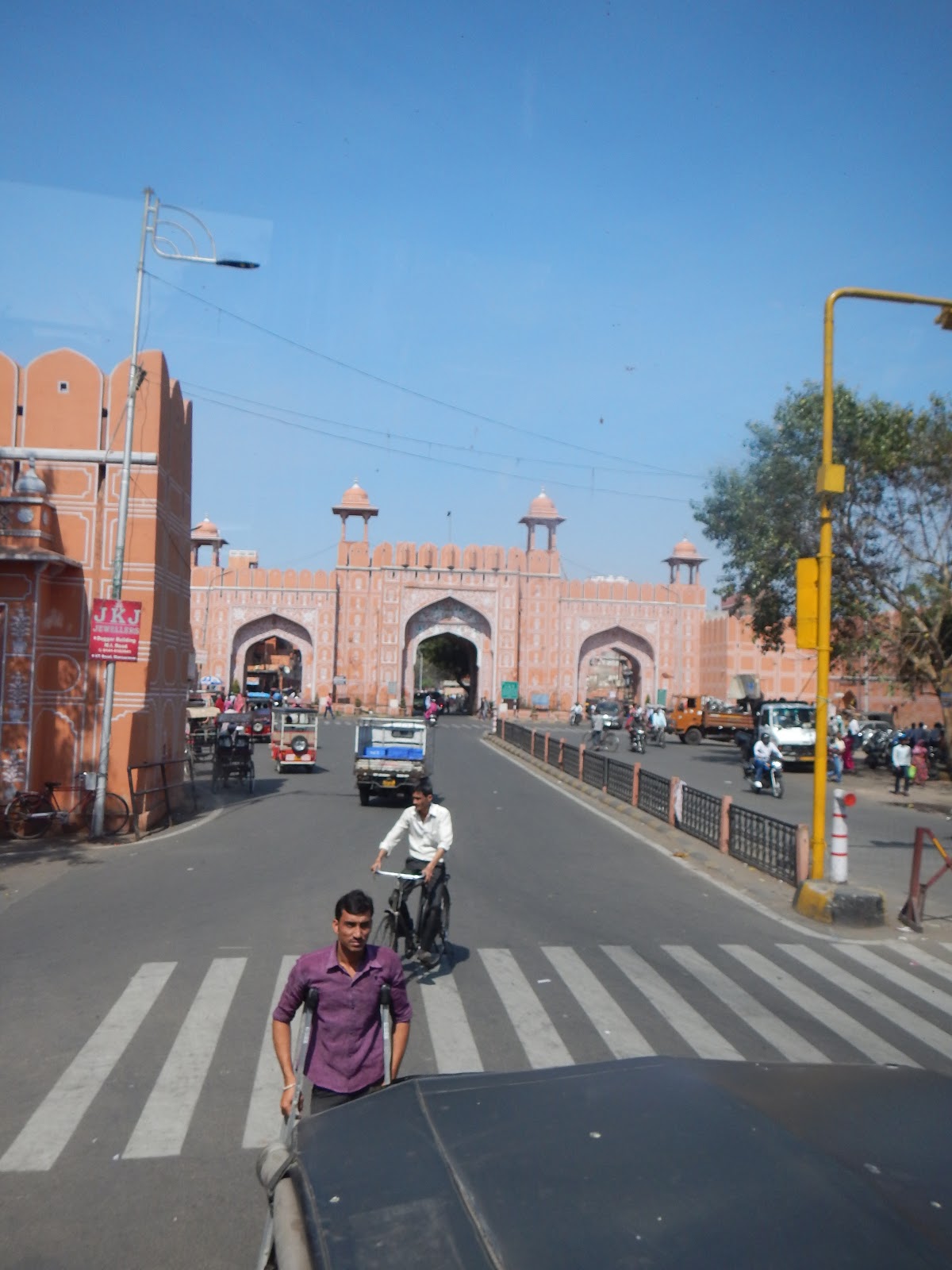
One of the gates into old Jaipur


Wednesday, March 9, 2016

India Textile Tour Day 3


Magnificent


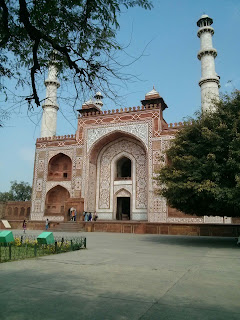
Front entrance, Akbar the Great tomb


Waiting for the train
Waiting for work
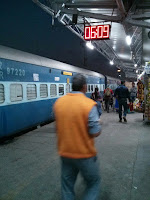
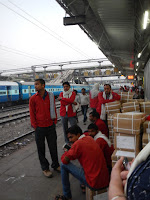
Up really early, and on the bus by 5:00 to catch the train to Agra. Trip through city streets already waking up to the train station. Indian train stations are a whole story unto themselves. Noisy, crowded and smelly. (Indian men will urinate ANYWHERE.) Caught the train with no problem and off to Agra.
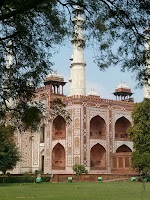


Akbar the Great's tomb
Bus was waiting and we got our garlands and off to Sikandra, a suburb of Agra, where we visited Akbar the Great's Tomb. This was built from 1605-1613, although Akbar had planned and started the tomb in 1600. Lots of marble mixed with red sandstone in about a 20 acre piece of ground. Long walks in the hot sun, but at least the humidity wasn't too bad.

All at once, there it is

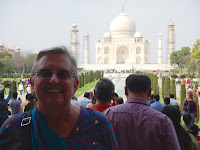
After visiting the tomb we went to lunch in Agra, then on to the Taj Mahal. I was very surprised by the area around the Taj. When I visited in 1977 the road outside was a typical, chaotic, Indian road. This has all been removed, and you park and are driven up to the entrance in an electric vehicle. This is to reduce the pollution that was destroying the marble of the monument. Through security, then everything is as it was earlier. The Taj is wonderfully white. Mud packs were used to remove the staining of pollution. In my pictures you will see scaffolding around the corner minarets where this process is on-going.

Masses of people, as Monday was a holiday for some religious festival, with myriads of foreign tourists, of which I was one. Hot and humid, with thunderstorms in the distance. I sat and admired the
Entrance to the Agra Fort
scene: the Taj does not disappoint.

Off to the Agra Fort, about a mile away from the Taj. By this time I was really tired, and elected to stay in the bus since I had seen the Fort before. Ninety-four acres, really, a walled city, was more than I could take at this time.

Back to the train station, then bussed to the hotel---wow, I'm tired.
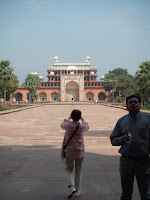
Balbir, our tour guide


I see this in a quilt, from the Taj entrance


India Textile Tour Day 2


The textile museum was part of the Craft Museum of India. Lots and lots of textiles, including extremely fine Kashmir shawls with weaving so tiny you could hardly make it out, as well as applique and kanta cloth. Problem with both presentation and lighting. There were no labels, so you weren't too sure what you were looking at, other than having a general idea, but, worse than that, the lighting, what there was of it, stunk. That said, it was interesting looking at all the different types of textiles made in India.

We had a very nice lunch at the cafe associate with the museum, the Cafe Lota. It served a “pan Indian” menu and seemed very popular with the locals. I had a lovely kachcha aam prawns curry.

Waiting to cross the road, the cars don't stop
After crossing the road (an adventure in itself) we went to the Dilli Haat, which is mainly a handcraft market. Spent an hour and half there. Since it was Jammu/Kashmir month, we saw a lot of pashima shawls and scarves.

Dinner was at the hotel where we're staying, the Metropolitan. Again, way too much to eat, mostly tandoori style...wonderful kulfi for dessert.

Pulkari, raw silk totally covering foundation fabric
Applique, tree of life
Appetizer, including fried spinach leaves, yum.
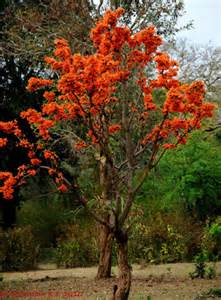
Flame of the Forest
Up early tomorrow for a train ride to Agra.
Indian traffic at its finest


Reverse applique from Bengal


Monday, March 7, 2016

India Textile Tour Day 1


I hate staying up for long periods...that said, I couldn't sleep on the plane, as usual and so was up more than 24 hours. I was so tired I barely remember putting my head on the pillow last night. It is now Sunday morning in Delhi, and we are going to a textile museum, but more on that later, probably next post.


The first lesson of India-patience
Left Dulles with snow on the ground, landed in Dubai where it was cloudy. Dubai strikes me as a beige country with beige houses, but since I didn't see any more of it that the airport, perhaps I'm being judgmental. Changed planes and on the Delhi. I must say, the Airbus A310 for the first part of the flight was nicer than the Boeing 777 on the second, but both flew just fine.

A nice welcome


Delhi is as always. Traffic worse than ever, with the lines on the pavement merely suggestions which are not followed---four lanes work as five, so why not? Nice being on a tourist bus, air conditioned. Air pollution is as bad as LA used to be, and I'm coughing already.


 After checking into the Metropolitan Hotel, in New Delhi near Connaught Place (a throughly western hotel like nothing I have ever stayed in in India before) we were taken to dinner at a tandoori restaurant, also very upscale. Food was excellent, but way too much of it. Great naan though, and I have never had paneer toasted like I had it last night. Very tasty.


Back to the hotel, to bed.

Thursday, March 3, 2016

India Textile Tour Day Zero

Jinny Beyer Studio
One of many quilts displayed


Not sure what to call today.  Day Zero is as good and anything else.

Actually left yesterday and flew from San Francisco to Dulles via Las Vegas.  Not a bad flying day, but Virginia was a brisk 28° with a slight breeze as I waited outside for the hotel shuttle.  Today is a free day, so I rented a car and drove to Great Falls VA, not to see the Falls, but to go to Jinny Beyer's quilt shop.  Man, could I have spent money there!! but didn't as I would have had to ship it all home.  All of her fabrics are available, along with kits, notions and patterns.

After lunch at a nice Irish pub called Old Brogue I did go to the Falls.  Cold, cold day and I nearly had the whole National Park to myself---33° doesn't bring out a lot of sightseers.  The Falls drop only 76 feet, nothing compared to Niagara, but were a barrier to westward expansion in the late 1700's.  George Washington and others formed a company to build the Patowmack Canal which used 5 locks to raise boats around the Falls. Since the rocks are schist, a hard metamorphic rock, they could not be blasted away.  The Canal was finished in 1802 but by 1828 ceased operation, chiefly because the newly opened Erie Canal provided too much competition.

Meeting on of my fellow travelers, Newbie, tonight, then on to India tomorrow---when it's supposed to snow here.